

The portuguese writer José Luís Peixoto (42 years) received, in Brazil, the most important award for literature in portuguese language, „Oceanos – Prêmio de Literatura em Língua Portuguesa“, similar to the „Man Booker Prize“. The event took place yesterday (on the 6th of december 2016). Unfortunately, only two of his novels were translated in Romania, „Nenhum Olhar“ and „Cémiterio de Pianos“, both at Polirom Publishing House.
Being tired of waiting his other books to be translated in Romanian and of searching his English editions, but also because he`s one of my favourites authors, I decided to interview him. I found out a lot of interesting thing, for example that José Luís Peixoto`s work is translated worldwide (in over 20 languages) and that some of his novels had a first print of 30.000 copies.
Lavinia Bălulescu: You came in Romania 7 years ago, at a festival in Bucharest. At that point, only „Nenhum Olhar“ was translated in romanian. One year later, „Cémiterio de Pianos” was translated and then the translations stopped. Do you know what was the reason? I know for a fact that there are a lot of frustrated readers in Romania who would like to read you in their language and are not able to do that.
José Luís Peixoto: Unfortunately, in the present days, I believe that the main reason why books stop being translated and published has to do with the comercial sucess, or lack of it. Most probably the publisher considered that the numbers of books sold were not enough to continue publishing. As an author, there’s not much that I can do and it’s very discouraging, specially because I still get a lot of mail and care from romanian readers. I wish there would be a romanian publisher that would feel interested in publishing some of the novels that I’ve written after those two. They have been very well received internationally.
And, if we talk about Romania, what romanian writers do you know (have you read or heard about)?
Mircea Eliade, Cioran, Ionesco are some of the authors born in Romania that I’ve read more widely. On different levels, they have touched me deeply. Still, unfortunately, I feel that there’s a lot great romanian authors that are completely unknown in portuguese language. I would love to find more contemporary romanian authors translated and published into my language.
When in Romania, 7 years ago, you said, in an interview, that thanks to the Jose Saramago Prize that you won with the novel „Nenhum Olhar” you can live only from your writing. I`m curious how is it going now? Can you still live from your writing? This is something strange for us, in Romania almost no writer can afford living from writing.
I have been living of my literary work for 15 years. Fortunately, things have been increasingly better. Since I was in Romania, my books were published in many languages. Today, my novels are available in more than 20 languages and that’s what makes it possible to live from my writing.
You had a project with the Moonspell band which consisted in a book and an album. Did you continue the project in any way?
Since then, we didn’t work on any common project. But we have a project that we are always working: our friendship. Maybe we’ll have some surprises in a near future.

PHOTO CREDIT: Sandra Nunes
How does a day in your life look like? An ordinary day.
It depends very much. My life is a bit bipolar. It’s usually divided between the periods that I spend at home, in Portugal, and the ones that I spend traveling to promote my books. I travel a lot and I don’t stop writing, but I prefer to stay at home and devote my full atention to writing if I’m working on a long project, such as a novel.
Do you still have columns? In which papers?
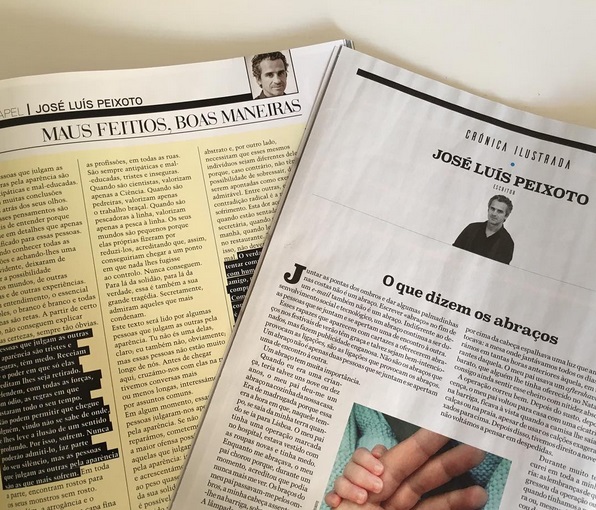
Currently, I write 3 monthly columns. One in a well-known weekly magazine, one in the magazine of the portuguese flight company (TAP) and one in a travel magazine.
I can imagine that people always ask you things about Saramago, how well did you know him, how was he in fact. I want to know if he ever told you something so strong that maybe changed you or helped you construct yourself as a writer.
I had the chance to exchange ideas with Saramago many times. He always advised me to focus on my work, not to loose sight of what’s really important. Besides that, his example was very important. Saramago was very active as a citizen and that’s something that I also payed a lot of attention too. Recently, my most recent novel was translated into spanish by his widow. She was the spanish translator of his novels and it was the first stime she translated a novel besides Saramago’s. It was an amazing honor for me.
How do you feel to always be compared to Saramago, to be called „The new Saramago”?
I take it as compliment and, also, as a responsability.
Do you think that Saramago changed the face of literature? How?
Great authors always bring something new and, by doing so, change the face of literature. Maybe I’m not the right person to evaluate in what way Saramago did that because I’m too close to him. I’m not a unbiased reader.

About the book “Nenhum Olhar”, you said in many interviews that, being your first novel, you wrote about what you knew, about your origins, using the mythology and also using the biblical symbols and characters. So the book is in fact asking a question, you also said that. What is that question that we should be thinking about after reading the book? And, also, we have the devil, the prophets, but where is God in that book?
Maybe that’s one of the main questions of the book. Even the title of the novel may be read in that way. But I feel that I’m not the best person to answer those questions. The readers are the ones who should know which are the most important questions that the book raises. I would just add that I believe those questions, in any circumstance, are deep. It’s a novel that deals with fundamental subjects.
Which one of your books is the most wanted, the bestseller? The one that people buy the most? And which one is your favorite? Some writers say their favorite is the most recent one.
I have several books that are very widely read. In Portugal, my last novels have a first print of 30 thousand copies. I have some books that have more than 20 prints. Besides that, they are very well read in countries such as Brazil, Spain, Italian and some more. As you may know, my novels are not exactly bestseller material, so I’m very happy that they are so well read. Personally, I feel that my most recent novels reach greater levels of literary achievement. That’s the case for example of „Livro“ („Book“) and „Galveias“ (the name of my hometown of one thousand inhabitants.

You once said that good writers are not always nice persons, nor the other way. Care to elaborate on this topic?
I was just stating the obvious, I guess. First of all, writers are persons. Any prejudice towards writers is doomed to be wrong.
I know that Faulkner is one of your favorite writers. I also read that you like Calvino, Cortazar, Antunes, Celine, Carver? Am I forgetting somebody? Do you have one single favorite book, that book that can beat them all, „THAT“ book?
It’s always difficult to answer what are the favorite writers and books. Usually, when asked that question, I answer the name of the books and authors that I remember in that exact moment and that have touched me deeply. That doesn’t mean that those are the only authors that have touched me and the ones that touched me the most throughout my whole life. The relationship with books (as it happens with all kinds of relationships) changes. It’s very hard to define a hierarchy and, I believe, it’s impossible to define a single book as the most important one.
You`ve mentioned that Antunes` work influenced you a lot. How?
Lobo Antunes is one of the most influential authors in contemporary portuguese literature. As a teenager, I was very impressed by his novels. It was in his books that I read for the first time a story with more than one narrator. Also, the fact that he has some novels that deal with aspects of recent portuguese history that were not fully explained to my generation was also very appealing.
„Cémiterio de Pianos” is based on a real subject, the death of the runner Francisco Lazaro. Also, you mentioned that „Nenhum Olhar”, as mythological as it is, has connections to the land of your childhood. My question is about your method of writing. I mean, do you need a starting point from reality and then you fictionalize? Or maybe you do something methodical, document the reality, make a research?
So far, the use of information connected to the reality that I know has been a way to write books that I may believe as valuable. The history of literature is long, a lot has been written throughout the centuries and in all cultures. It’s difficult to find something that was not written before. Part of my way to deal with that is to use my experience as a subject. But as I’m writing fiction, I rearrange that data, I mix it with lots of other elements, of course.
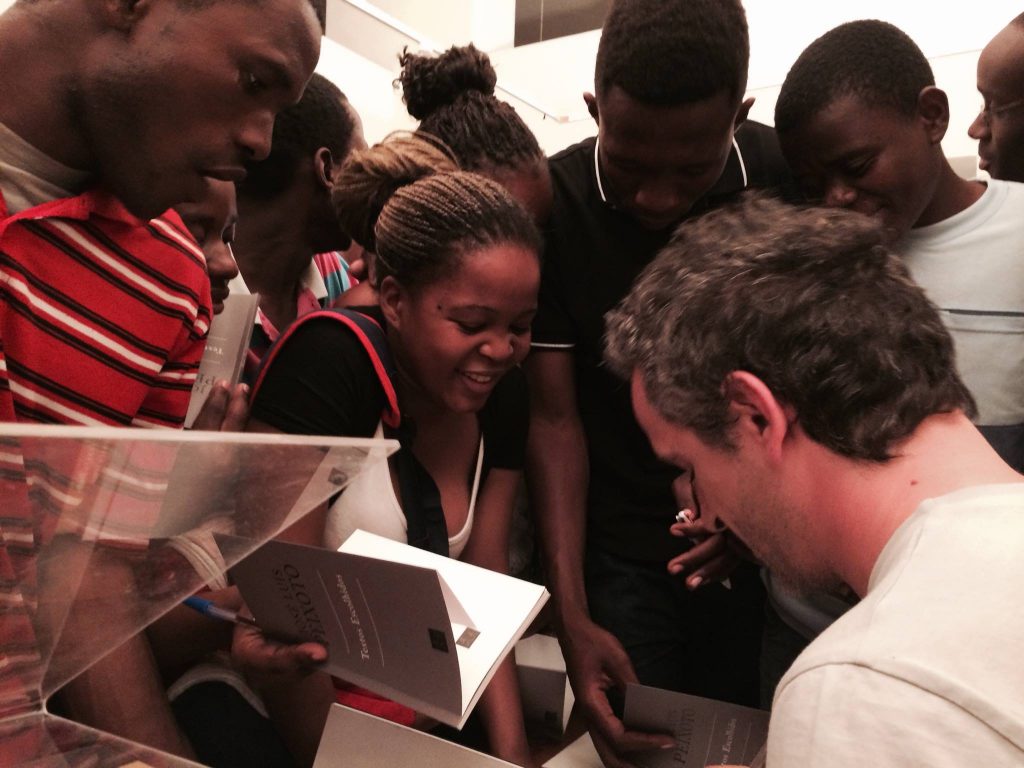 PHOTO: Peixoto, in Mozambique
How do you write? I mean, what do you use? Maybe a laptop? Also, do you write with a plan? Do you have a routine?
I use paper and I use a laptop. I write in all parts of the day. The routine I have depends on many aspects of my life in that precise period.
You also wrote a book of memoirs of your travel is North Korea. How come?
Writing always demands a challenge. At a certain point, I felt that I needed to do something different from all I had done before. I was in Los Angeles at the time, promoting a book of mine and I was staying in a part of West Hollywood called Koreatown. Maybe because of that, one day I dared to consider going to North Korea and writing about it. I became really enthusiastic about it and, one and a half year later, I went to North Korea for the first time. Altogether, I went four times to North Korea to write the book. In one of those times I stayed for a whole month. There, I learned many things and, today, that’s a fundamental book among my work. It was the starting point of my work regarding non-fiction and traveling, which is related, in some ways, with my fictional and more introspective work.

Seems to me, just by watching your Instagram, that you`re travelling a lot, to so many different places, from China to Venezuela or to USA. How come you travel that much and which parts of the world are your favorite destinations, your interest zones?
I travel mainly for two reasons: to promote the international editions of my books and to write about my travelling. I am a regular contributor to the two biggest travelling magazines in Portugal and in Brazil. That’s something that I’ve been doing since 2009 and that I love doing. Right now, the part of the world that interests me the most is Asia.
What`s your favorite place in the whole world?
Next to my family.
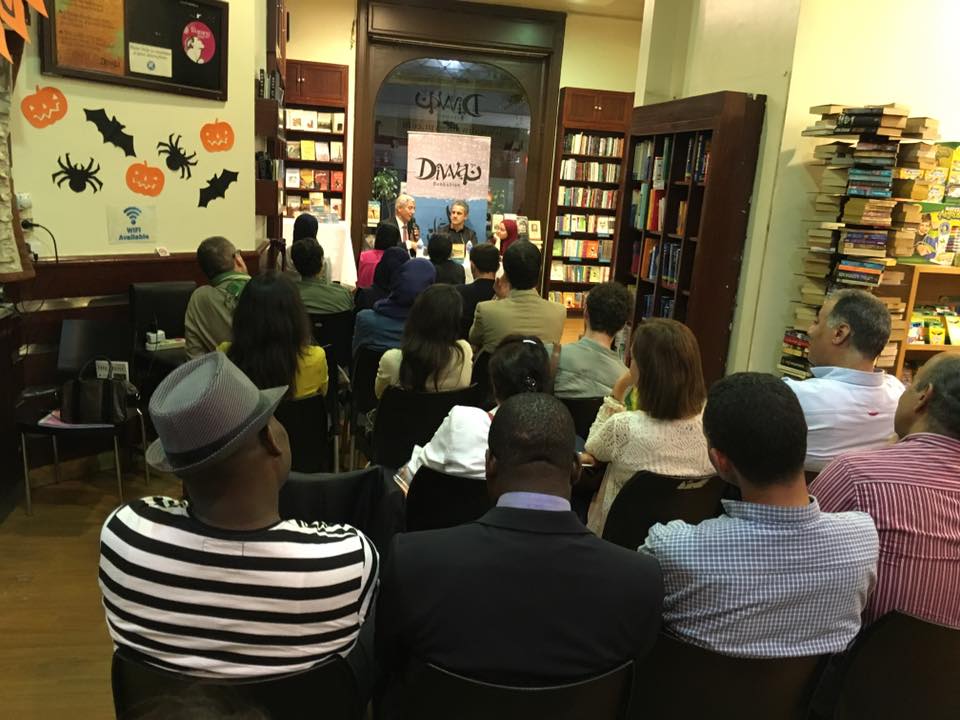
PHOTO: Peixoto in Cairo
What kind of movies do you watch, what favorite directors do you have? And about music: does it have any role in the creating process?
I consider myself very eclectic as a consumer of art. Of course that I have my favorite directors, movies and so on, but it would be a big list and, also, that’s a list I’ve never done. As far as music is concerned, I’m also interested in all kinds of music. Still, lots of people know me from my connection to Metal and a few extreme genres in the Rock area. In 2003, for example, I did a book of short-stories that was conceived and published together with an album from the famous Portuguese Metal band called Moonspell. I believe they are well-known in Romania. Besides that, I have many other connections with Metal. In the exact moment, for example, I’m writing all the lyrics for an album of another portuguese Metal band. But I’ve worked with a big number of musicians. I’ve written lyrics for Hip-Hop, Fado, Rock and many other genres. I’ve even written a full opera libretto. My relationship with music is long and too complex to describe in these lines.
And about movies: can you imagine one of your books turned into a movie?
I would love that to happen, but I don’t feel any interest to be involved in participating in it. I wrote the novels, that was my contribution. If someone wants to adapt any of that, it will necessarily be a different work.
You have a tattoo on your arm with the name of Faulkner`s invented land, Yoknapatawpha. Also you have a tattoo of a frame, an empty frame. How many tattoos do you have and what do they represent?
Yes, it’s true, I have several tattoos, don’t know exactly how many because they are not separated from one another. In a way, tattoos are like writing and publishing, with the difference that tattoos are not necessarily a message to others. Actually, most times, tattoos are something very private and other people have nothing to do with it.

PHOTO: One of Peixoto`s tattoos. In the middle of it, a drawing by the art director Diogo Paulo
And another one about your tattoos. I also saw that you ask different people to draw you stuff inside your tattooed frame. What`s the most interesting stuff somebody draw there?
The most interesting thing that came out of it was not exactly drawn inside the frame. Maybe the most incredible was that, to my knowledge, two other people also tattooed similar frames and also ask people to draw inside of it. That left me thinking.
You also wrote a book for children, “A Mãe que Chovia” (“The Mother that Rains”). What is it about?
It’s a story of a boy whose mother is the rain. This is, of course, a metaphor of motherhood and some issues related to that subject. I was very happy to the incredible response that book had in Portugal and in Brazil. A few months ago, I published my second book for children. The title of it is: “All the Writers in the World have their Heads Covered with Lice”.

Talking about this children book, what was your motivation for writing it?
I love to write in different forms. Sometimes, I doubt a bit that these two books are limited to children only but, fortunately, they are read by reader of all ages.
Your most recent book, “Em Teu Ventre” (“In Your Womb”), was published in 2015. What is it about?
It’s a book of about 160 pages and it deals with a very sensitive issue in Portugal: the apparition of Virgin Mary to three children in Fatima in 1917. Besides that, it’s also a text about motherhood. The family is a subject present in many of my books.
What are you writing now?
I’m writing a non-fiction book that has to do with travelling.
Who`s your first reader?
Usually, it’s my wife or my older sister.
A lot of what you write is death-related (your first title, “Morreste-me”, included). Even though you may say that this is a general truth, that everything in life is death-related, I’m still interested how do you relate yourself to death.
One day I will die, that’s my main relationship with death. I feel that’s a very powerful subject. Death in itself is a question. Most my books deal with that subject. It’s a deep, fundamental issue. Anything that I might say in two or three lines about it will necessarily be superficial.

PHOTO: Peixoto, in 2003
I am curious how do you perceive “the now”, the “universal now” on this planet. I`m talking about all the present conflicts, all the terrorist attacks, the wars and the never ending feeling of danger. You, travelling a lot and talking to a lot of different people, might have another view regarding to these concerns. Do you think that the world map might modify in the nearest future? Or maybe we are just too pessimist?
I was born in the seventies, in a bipolar world. Today, the world is multipolar and that brings much higher risks. There’s a lot of bad moments in history that I thought that were gone and that, today, I feel that we are condemned to repeat. It makes me sad and fearful of the future.
What are you searching for? I mean, when writing, what is in fact the question? What`s your biggest question?
My biggest question, the one that’s underneath all others, is: «Who am I? “.
What’s your first memory on this planet?
I remember being summer, being with my parents in a house by the sea, and I remember thinking: I am four years old. I remember the strong sense of identity. It is as if in that moment I realized that I existed.
What is José Luís Peixoto doing in another world, in a parallel universe?
Sleeping, I hope.
PHOTO CREDIT: Patricia Pinto (first photo), Facebook José Luís Peixoto, Instagram José Luís Peixoto.
Find out more about José Luís Peixoto from his website, JoseLuisPeixoto.net.
